Saturday, March 30, 2013

Short Reviews

From Dusk til Dawn (Rodriguez, 1996)
It's like two grindhouse movies stuck awkwardly together, with a sudden shift in tone and authorial vision. The first half if like hyperbolic Tarantino, with some of his most risqué and blatantly tasteless plot twists. The second half is Rodriguez going super cheesy and over-the-top with his porno horror comedy. Horror comedies never really work out, and this is no exception to that general rule. Yet there are some clever sight gags: a cross made out of a shotgun, a collection of trucker bric-a-brac, holy water filled condoms and water guns, a disco ball turned into a rotating gun of sunlight. A strange sentimentality and attempts at emotion that pervade the second half of the film strike as a little too much, and out of place amongst the mayhem -- and perhaps this entire stew is purposely incongruent.
Like most of Tarantino's scripts, there is a pervading element of morality, as characters grapple with conventional ethics. A rape motif runs through, with Tarantino himself as a crazed, raping, murdering and 'a little bit slow' psychopath -- and is unsurprisingly the most memorable character of the bunch. He doesn't understand basic ethics, and has a child-like behaviour mixed with brutal sadism, like an id gone wild. But is it the most powerful evidence I've seen yet of Tarantino's ideological problems? Oh yes.
B-

CSA: Confederate States of America (Willmott, 2004)
-as subtle as producer Spike Lee's Bamboozled, but thankfully without the awful melodrama.
-too much emphasis on race, and a belief that it is not the insidious and sly racism but the over-the-top minstrelsy that dominates American race relations
-full of questionable historical revisionism: Canada as Russia? Slavery really still exists?
-acting in commercials, recreations and meta-media is too hokey and corny, far beyond tongue-in-cheek into the eye-rolling.
-cheap jokes are the most effective
C

Galaxy Quest (Parisot, 1999)
-goofy, silly, obviously clever but still a delight. It doesn't bite too deep or too harshly, so that genuine fans of science fiction and acting has-beens will laugh at themselves rather than feel offended. It's gentle jabbing instead of mocking, and more of a celebration of Trekkie geekery than a tear-down.
-inventive visuals
-quick and clean narrative, a game cast (although more to be desired with the female roles, the only two worth mentioning inevitably love interests).
B


Winter's Bone (Granik, 2010)
Chilly drama
-Jennifer Lawrence's star-making performance is lived in, with nary a false note
-some could accuse the film of painting a portrait of the coal belt as a backwards cesspool, but instead the film is really showing the underbelly of any society: we do see so-called 'normal folk' doing normal things, like going to school or running a farm that is more than just scraping by.
-haunting moments, like in the climatic boat scene
-beautiful cinematography
A


Lock, Stock and Two Smoking Barrels (Ritchie, 1998)
Tarantino-lite, with far too many self-consiously clever twists and turns. The plot is near impossible to follow, and I had no real desire to actually figure it all out, unlike the best of the subgenre. It's not thrilling, it's exhausting. Best moments are in the English goofiness and violent slang.
C


The Young Victoria (Vallee, 2009)
I'm a sucker for handsome costume dramas, and this one didn't let me down. Yes, the narrative is a bit too condensed, and ends awkwardly, but the production design is absolutely stunning and the acting top-notch. Jean-Marc Vallee directs with flair.
B+

Valhalla Rising ()
Molasses-slow and groggingly "heavy", elliptical to a fault. As a mood piece it's near parodic, but when it works, it is intense: a drug trip with droning guitars is simply stunning.
C-

Bernie ()
Rather delightful comedy with a fantastic leading performance by Jack Black. Just the right amount of whimsy, kitsch and dark humour, with a mockumentary twist that actually works quite well. Unsurprisingly, some of the real townsfolk were involved in the making of the film and even show up as interviewees.
B+





Monday, March 25, 2013

"Recommend me some movies!" #2: A little bit arty

You've seen a lot of the Hollywood stuff, and you want to go a little deeper down the cinema rabbit hole... but not too much. This set of films tries to avoid the "that's a bit too weird" and the "I didn't get that at all" potentialities (well, mostly), but wants you to expand your repertoire beyond contemporary and recent mainstream cinema. Many of these films would fit well into an Introduction to Film Studies course, and I've even taken inspiration from courses I've taken or even helped teach. What would you recommend?

European Art Cinema
Post-WWII, often attempting a more radical approach to narrative, featuring the use of psychology and intense characterizations over plot. The question is not "What's going to happen next?", but instead "Why is this happening?". Various "new wave" movements sprung up during the 1960s, lead by young filmmakers who reacted against what Cahiers du cinéma called "daddy's cinema".


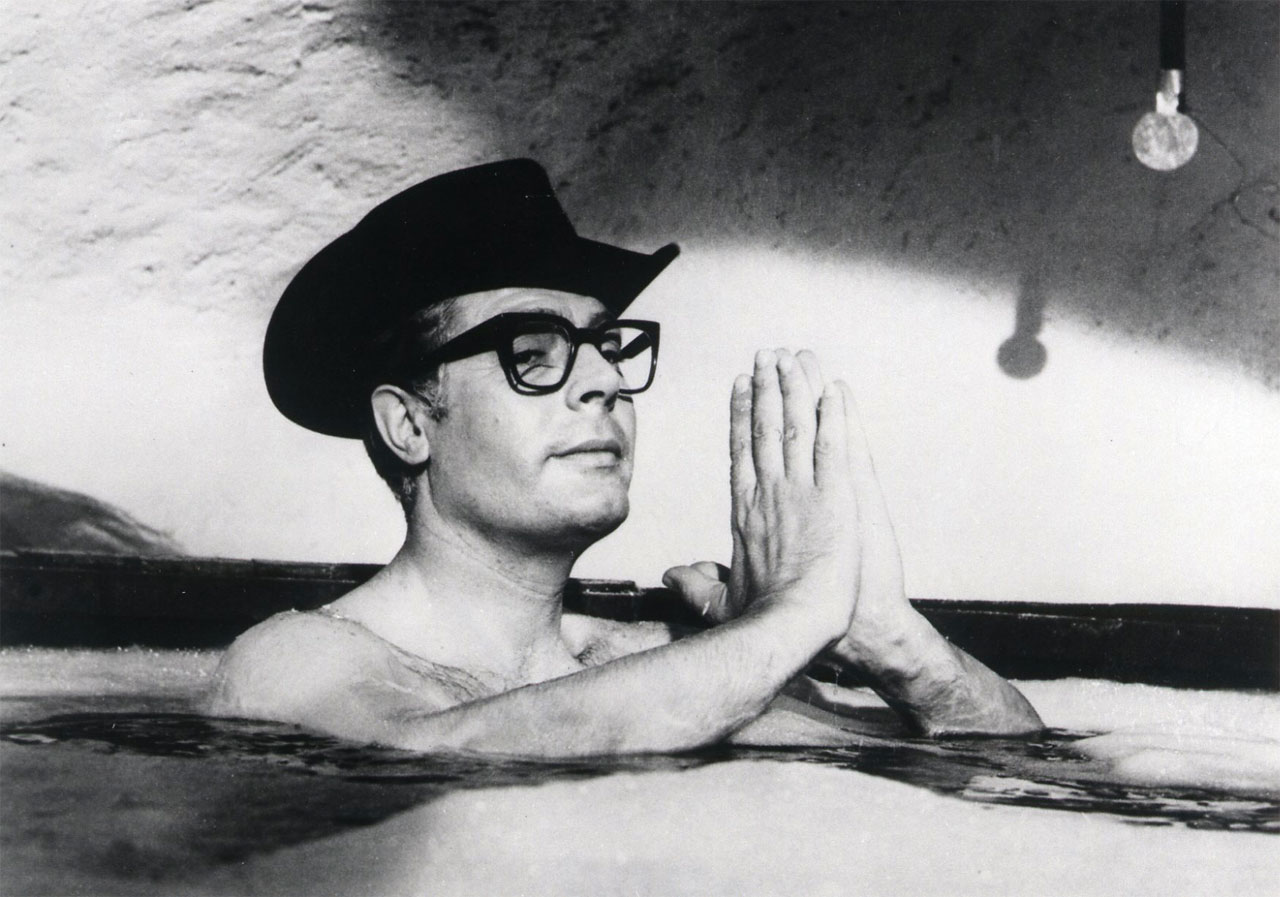
8 1/2 (Federico Fellini, 1963, Italy)
One of the towering achievements of cinematic history, Fellini's elliptical, wandering, ambitious and surreal film is an art house epic. Hugely influential, this film is among the most difficult on this list for some audiences, while others will eat this epic up.

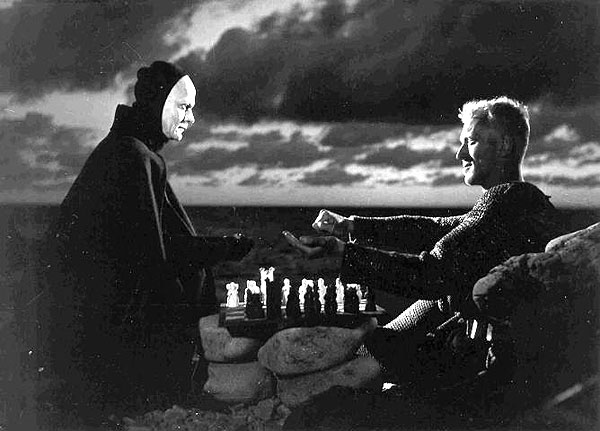
The Seventh Seal (Ingmar Bergman, 1957, Sweden)
A good introduction to the stoic cinema of Sweden's premier auteur, Ingmar Bergman. A medieval knight goes on his business while being stalked by Death himself as they play a game of chess.

Ali: Fear Eats the Soul (Rainier Werner Fassbinder, 1974, West Germany)
Fassbinder was one of the most prolific directors out there, but this surely ranks as his most heart-wrenching yet accessible of his work. Excellent performances dominate.


Shoot the Piano Player (François Truffaut, 1960, France)
Truffaut's thriller-comedy-tragedy of a second feature film is far more playful than his seminal debut The 400 Blows (1959), but still features many of the same qualities that made the French New Wave so integral to film history.

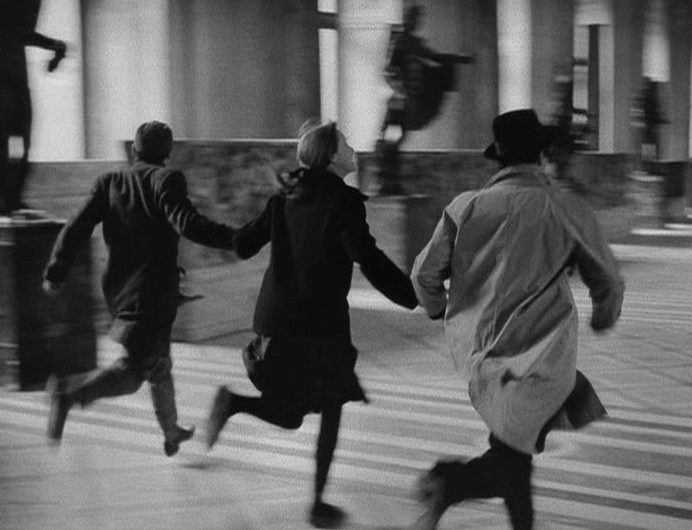
Band of Outsiders (Jean-Luc Godard, 1964, France)
Like Shoot the Piano Player, this is Godard at his most playful and loose. Anna Karina, Godard's future wife, is simply delightful in every film she appears in, but rarely moreso than here. Look for an impromptu dance sequence that surely ranks as one of the most marvellous sequences in cinema.


American New Wave/The New Hollywood
Young filmmakers react to Classical Hollywood and the collapse of the Production Code that forbade many 'controversial' topics and their depiction.

Taxi Driver (Martin Scorsese, 1976)
Robert DeNiro's iconic performance as Travis Bickle is only one part of Scorsese's haunting masterpiece. It's dark, gritty, melancholic and profoundly disturbing -- and yet somehow supremely entertaining.

Blue Velvet (David Lynch, 1986)
Although too late to be considered a true member of the New Hollywood, Blue Velvet remains one of the most integral of American films. Similar to Taxi Driver in that it's the disturbing portrait of the evil that lurks under the veneer of the American Dream, Lynch's masterpiece is a surreal mystery film with some of the greatest performances out there. Dennis Hopper truly disturbs as the unknown-gas-sniffing, sexual deviant and psychotic Frank Booth: one of cinema's greatest villains.

M*A*S*H (Robert Altman, 1970)
A little bit different than the spin-off television series, Altman's film is more biting, satirical and even a little bit bawdy -- but always worth a good belly laugh.

Annie Hall (Woody Allen, 1977)
This Best Picture winner is sometimes maligned by fanboys as the film that beat Star Wars for the Oscar, but it's difficult to argue after having seen it. Hilarious from start to finish, with some miraculous filmmaking skill and wonderful non-sequiters. Diane Keaton justly won the Academy Award for her iconic performance as the titular Annie Hall.

The Last Picture Show (Peter Bogdanovich, 1971)
This stark coming-of-age tale was one of the major breakthroughs of the New Hollywood. A melancholic and moving view of a small mid-west town, with strong performances and homages to Classical Hollywood cinema.


Silent Cinema
While there are many places to begin with an incredible wealth of material, it seems that many audiences either don't know where to begin or are hesitant to start, afraid that they will be bored.

Nosferatu (FW Murnau, 1922, Germany)
This unauthorized version of Dracula was almost completely destroyed by Bram Stoker's widow. Thankfully, she didn't succeed, and we now have the ability to see one of the most entertaining and effective of all silent films. Max Schreck's remarkable performance as the vampire has become the stuff of legend, with fanciful suggestions that he was indeed a vampire himself (the basis of the 2000 film Shadow of the Vampire): how else can you explain those hypnotic, unearthly movements, and that incredible stare and makeup?

Metropolis (Fritz Lang, 1927, Germany)
More hypnotic movements in this German Expressionist masterpiece and one of the most influential science fiction pieces. The narrative is near-mythic in its battle of good and evil, but it's the massive visuals and the towering art direction that make this a must-see for anyone who considers themselves a lover of cinema.

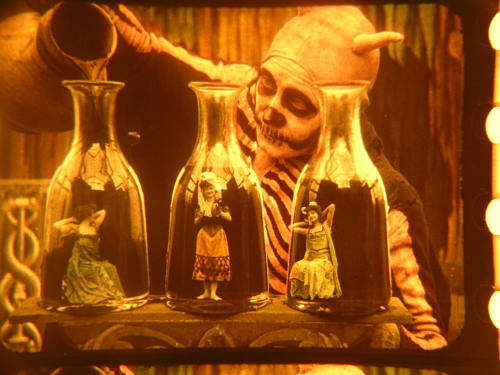
The Red Spectre (Sigundo de Chomón and Ferdinand Zecca, 1907, Spain)
This is one of my professor Tobias and mine favourite films, and a perfect example of what Tom Gunning calls the Cinema of Attraction. A devil-like figure performs tricks and magic.

Un Chien Andalou (Luis Buñuel and Salvador Dalì, 1929, France/Spain)
No art house list would be complete without Un Chien Andalou. Just watch it, and don't read anything about it before you do. You'll, uh, thank me.


Three East Asian Films

Late Spring (Yasujiro Ozu, 1949, Japan)
Ozu's meditative style is often called the 'most Japanese' of his peers, with a purposeful but slow pace and muted yet strong emotions. Late Spring may be considered by many as lesser than his masterpiece Tokyo Story, but I find the film to be one of the emotionally powerful films ever made. A widowed father watches as his only daughter goes through the milestone of marriage.


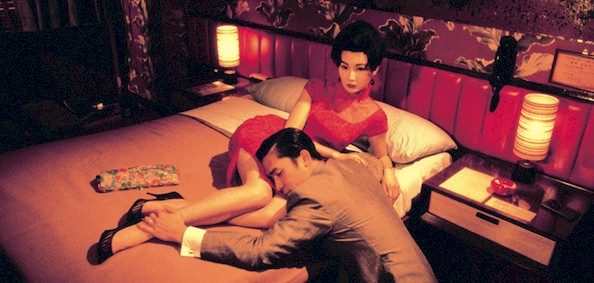
In the Mood for Love (Wong Kar Wai, 2000, Hong Kong)
Contemporary Hong Kong auteur Wong Kar Wai made quite a splash with this film just over a decade ago. It's oozing with passion from every shot, and the romance is humid yet never quite consummated. A beautiful film.

Rashomon (Akira Kurosawa, 1950)
One of my personal favourites, Rashomon is Kurosawa at his most focused and inventive. Multiple people have witnessed a murder, but each have different stories to tell of exactly what happened. Who is telling the truth? Is there any way that we can determine this?

Thursday, March 21, 2013

Quick Reviews


Gentleman's Agreement (Elias Kazan, 1947)

Could be described as one of those "vegetable movies" that are 'good for you', perfectly nutritious and tasty in its own right, but not one that you're too keen on anyways. The story is simple: a journalist pretends to be Jewish for 8 weeks in order to write a story on anti-semitism. Quite the timely film, especially given that the Second World War and the Holocaust were only a few years prior.
The film is marred by a script that simultaneously tries to be serious and casual. The result is a mannered overacting, with the leads of Gregory Peck and Dorothy McGuire having Serious Discussions while romancing, trying to be naturalistic --Kazan's specialty with the Method school of acting, used to glorious effect with Brando a few years later in A Streetcar Named Desire and his other Best Picture winner On the Waterfront, also nabbing him his second Oscar-- but the dialogue is just far too written. No one speaks like this, and when the film is trying so hard to attain a sober realism mixed with a New York looseness... it just doesn't work out as much as the filmmakers are hoping.
Yet the supporting cast is fantastic, with Anne Revere (Mrs. Green), John Garfield (Dave Goldman) and a young Dean Stockwell each giving excellent turns that do manage to be naturalistic and loose. Celeste Holm won the Oscar for her supporting turn as gossip columnist Anne Dettrey, and it's not undeserved: she succeeds with the over-written dialogue, turning it into a wounded urbanite droll with just the right amount of near-screwball bubbliness.
There are some stunning moments in the film that profoundly capture the experience of bigotry: the silence of other guests at a hotel, the heartbreak of a child that has just been called a racial slur, the flippant aggression of a drunken man.
You could say why not just hire a Jewish writer? --but the point is that Green is someone who temporarily shifts his privilege, going from one identity to another despite looking and acting the same. Understandably, this film is used in school curricula, although I suspect the dryness of the film may turn off the students whom could use this message the most.
My favourite exchange, which slyly hints at some other forms of discrimination:
Tommy: "I don't like fruit."
Mrs. Green: "You like bananas."
Tommy: "Well, they're different!"
B+


Grand Hotel (Edmund Goulding, 1932)

Broad melodrama, and an early example of the portmanteau multi-narrative film, where we watch the activities of overlapping groups of people as they go about their business (Airport, Ocean's Eleven, Magnolia, The Rules of the Game) The film features some extravagant overacting from Greta Garbo as a neurotic ballerina, which actually turns out to be rather delightful. But the highlight of the film for me is Lionel Barrymore's Otto Kringelein, a meek accountant with a terminal illness who decides to live out his final weeks in luxury. It's a performance dripping with pathos and humour, and the character happens to be the polar opposite of his Mr. Potter from the classic It's A Wonderful Life.
Joan Crawford plays a young stenographer with razor-sharp wit and a bit of bubbly girlishness. It's a surprising turn, especially for us who are accustomed to her more serious or campy roles from later in her career. In fact, the grand cast as a whole is just excellent, but the filmmaking craft itself is not to be ignored, either. Brisk editing, interesting stories, and old Hollywood charm with just the right amount of camp from director Goulding.
A


Suspicion (Hitchcock, 1941)

Hitchcock lite, but an interesting turn for the director as it emphasizes the romantic comedy above the suspense. Joan Fontaine earned an Oscar for her performance, which I must admit I don't quite understand. I found her to be a near-parody of the chaste, bookish 'good girl', and lacking the depth that Cary Grant gives to his role. He is fantastic, as usual, in his turn as playboy, charming bastard and possible murderer. Hitchcock seems to be on auto-pilot here, without the sometimes goofy expressionism and flair he gives his other films.
B


The People vs. Larry Flynt (Milos Forman, 1996)

Milos Forman at his most biting, it's a material match made in heaven. Only his early Czech works stand up to it in pure political satire, but this is just another reason why Forman is in my mind one of the premier directors of the second half of the 20th century. We have our fantastic performances: Woody Harrelson is dynamite as the titular loveable slime ball, and Courtney Love is every bit as good in her doppelgänger role. Forman's pacing is swift and furious, with hardly a breath taken between zingers, and the film's loose feel fits perfectly. His ironic use of classical music adds to the delicious veneer of respectable scum, and we genuinely care for these riff-raff of porn pedlars, cheering as they defend their freedom of speech... even if we find them tasteless, vulgar and pretty much some of the most disgusting caricatures of America. Edward Norton shines in a supporting role as Flynt's long-suffering lawyer and fierce advocate.
A+


Tootsie (Sidney Pollock, 1982)

The relationship between men and women in the modern world: it's a theme that's been done a million times, but for whatever reason, 1982 was a year in which Hollywood cinema was bursting at the seams with gender theory. Victor/Victoria, The World According to Garp, The Best Little Whorehouse in Texas... and the most popular of them all and second-highest grossing film, Pollock's Tootsie.
Where to begin? The script! Oh, the crackling script.  Just some of the gems:
"I never said I love you -- I don't care about you! I read The Second Sex. I read The Cinderella Complex. I'm responsible for my own orgasms. I don't care! I just don't like to be lied to!"
"I was a stand-up tomato: a juicy, sexy, beefsteak tomato! Nobody does vegetables like me. I did an evening of vegetables off-Broadway. I did the best tomato, the best cucumber... I did an endive salad that knocked the critics on their ass!"
But the film also features a near movie-killing awful score that sounds like a cheap 70s television drama. A song montage at a farm is simply wretched, yet was inexplicably nominated for Best Original Song at the Oscars (as was the film for Sound, for reasons unknown). Jessica Lange won the Supporting Actress Oscar for her role as Hoffman's love interest, but it's Terri Garr's performance as Sandy is the best of the lot, besides Hoffman's powerhouse role as the gender-bending cross-dressing 'masculine woman' Dorothy Michaels. It's an astonishing turn, and testament to Hoffman's talent.
A-


Sunday, March 3, 2013

Quick Review: "The Boys from Brazil"

The Boys from Brazil (Franklin J. Schaffner, 1978)

Three Academy Award nominations: Best Actor in a Leading Role (Laurence Olivier), Best Film Editing, Best Original Score

A thriller with a tinge of science-fiction, The Boys from Brazil is a rather campy romp, and really only enjoyable when seen through this light.

The acting as a whole is pretty awful, with a plethora of supporting and cameo roles from wooden actors giving just wretched performances. At the centre are acting legends Laurence Olivier and Gregory Peck, who chew through the scenery and are clearly having a good time. It's an infectious attitude, and with a strong supporting turn from another legend James Mason, it's a breezy entertainment.

Olivier managed to nab an Oscar nomination for his role as aging Austrian Nazi-hunter Ezra Lieberman, and it's not entirely without merit. For the first stretch, his character may seem a bit too much with his thick accent and overt mannerisms, but by the end it's a lived-in role. We view Lieberman not as a caricature --which he seems to be at the start-- but instead as a fully fleshed, if eccentric, character. But the star here is Gregory Peck as Dr. Josef Mengele, the infamous Nazi "Angel of Death". As a physician in Auschwitz, Mengele performed many human experiments and murdered thousands of prisoners, his research focussing on heredity, twins and abnormalities. They're a powerful acting duo, and are clearly trying to 'one up' another to see who can have the juicier performance.

Schaffner's film is a bit deranged, which I think is a given considering the material: the clones of Adolph Hitler being born around the world, and now a plan to murder the adoptive fathers. Why? To mirror the adolescence of Hitler himself, whose father died at 65, and ensure similar environmental conditions. 

I see...

Of course, it's a ludicrous plan, as much as they try to make it seem legitimate with a scientist explaining (pretty accurately) the process of cloning.


Science!

But of course, the flaw is in the environmental conditioning: the good old argument of nature vs. nurture. This, of course, is why Mengele goes with 94 clones instead of just a few: quantity. Sure, it may ignore the political, ideological and economic conditions of Hitler's childhood, but at least  one will turn out the same, right?


Unfortunately, Jeremy Black's performance as the Hitler clones is just about one of the worst performances I've seen from an A-list Hollywood film. "But Andrew, he's just a kid!" Yes, and a kid with zero acting chops. His attempts at a British accent are hilarious.

"Dohn't you understAAAhnd, you AHHHHss?"

In his German form, he's a budding Nazi youth with a clarinet, practically screaming at his mother and on the edge of muttering some Ayrian supremacy. But I must admit that he is one creepy looking kid, with that jet black hair and piercing blue eyes.

I mean, just look at the bastard.


James Mason is a lone bastion of restraint in the bunch, which is remarkable considering his character: a suave, urbane and even effeminate Nazi. I've always though that Mason is one of the greatest actors of his generation, and if he can manage to bring some hint of depth and even subtlety to something like The Boys from Brazil? Well, kudos to you, good sir.

Easily his most fabulous role, darling.


But the film is primarily a golden artifact of camp. I mean, just take this exchange, which clearly counts as one of the greatest in Peck's career:

"Shut up, you ugly bitch."


Or this insert, with a Hitler clone cackling wildly as his mother discovers two dead bodies upstairs:
"NAAAAANCY! NAAAAANCY! HAHAHAHAHA"

And seriously, who takes the time to write the name of your archenemy on the board, menacingly askew?

"KAAAAAAAHHHHHN!"

So it's certainly an entertaining flick, with a trio of great actors giving flashy performances and a pretty bonkers narrative. But it doesn't help Schaffner's reputation in my eyes, whom I've found to be a pretty mediocre director. Patton was helped by Scott's legendary performance and a decent script by Coppola, but otherwise, I'm not finding much to praise.

What else? Jerry Goldsmith's score seems to be in on the campiness, with its main waltz motif almost sarcastic in its playfulness. The editing is remarkably clunky, surprising given Robert Swink's pretty fantastic filmography. Steve Guttenberg (whom you may remember from Three Men and a Baby) is simply wretched in his (thankfully) brief performance as a rookie Nazi hunter who uncovers the big plan.

B+

Monday, February 25, 2013

"Key to the City" Short Review

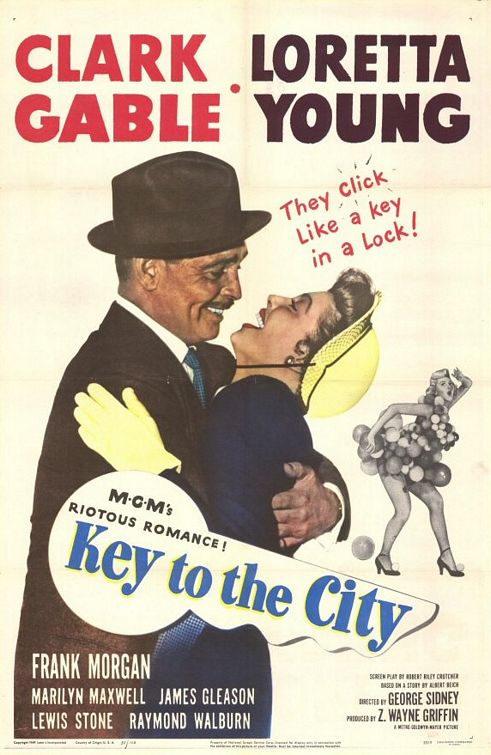
Key to the City (George Sidney, 1950)

"MGM's riotous romance!", and also one of the most chaotic, sloppy narratives I've seen... hilariously inept. Most of the film is made up of elaborate setups, much like other screwball comedies, but instead of witty hijinks, we get frustrating, dragged out flops.

A conference in San Francisco has small-town mayors from all over the country convening. Gable plays the rough-and-tuble former pier worker and mayor of an industrial city, and Young plays the eloquent, educated mayor of Winona, Maine, population just over 30 000. They meet, shenanigans ensue, they fall in love, misunderstandings split them up, the reunite. Ta-dah!

The formula is simple and classic. Many enjoyable films follow the same steps, each with a different set of twists. But these twists? Oh boy.

Just one of the bizarre high-concept setups: Gable is decked out in a Little Boy Blue outfit for a costume ball, which his fire chief --Frank Morgan in his final performance-- got for him. He gets locked out of his room, searches for some staff, gets exposed, some homophobic gestures, the standard. Soon he's outside, hiding his outfit under a trench coat, but his bare legs visible. He then meets Young, dressed as a little girl complete with blonde curly wig and Madeline hat.

Yes, really.

Screwball romantic dialogue ensues. A police office then stumbles upon the two, mistaking it for "soliciting a child". Gable tries to explain that it's not what it appears to the man, who they still don't realize is actually a cop. But Young wants to be snarky, and decides to play along:
"The big man pinched me!"
And thus they end up in jail.

For the second time.

How about their take on the man-woos-hard-to-get-woman: one of the worst 'love scenes' I have come across. In pea-soup fog on a Telegraph Hill bench, Gable creepily nudges closer and closer to Young as she scuttles away. He romantically lays his head next to her and tries to woo her, as she tries to act graceful and ignorant of his approaches... while looking clearly uncomfortable. Like, actually scared. The doe-eyed music suggests romance, but with a more ominous score...

MURDER.


It really is a shame, because the basic storyline is a good one, and the paring of Gable and Young --real life lovers, remember?-- is a crackling one. They have genuine chemistry, although Gable seems to find the whole preceding a little bit silly.

Raymond Burr is his creepy self, complete with switchblade and 'stache, playing a corrupt city official. I need to see more of this guy, because I always find him just deliciously villainous. Marilyn Maxwell is quite the bombshell in her role as exotic dancer (doing the 'Atom dance', in which she dances around covered in balloons that she pops strategically), and even gets to fight with Young in a bizarre scene.

And to leave off, some good old-fashioned racial caricatures. A small Chinese boy walks around the police station, chanting "Lychee nuts! Chinese lychee nuts!" in a heavily accented voice, attempting to sell some to the Chief. And because he's Chinese, he has to be a shrewd little bugger, right? He bites down on a coin to check if it's real. He tries to swindle the Chief of some money. All while being oh-so-cute and Chinese! Awwwww!

C-

85th Academy Awards Telecast Review

Seth Macfarlane is a divisive figure, and this is exactly why he's a poor choice. His Family Guy humour delights some, drives others nuts, and flat-out offends a good chunk. So why give him the reigns over the Academy Awards? It seems that each year now the producers try to make the ceremony "younger" and "edgier", and these attempts inevitably fail. With Macfarlane, it seems that they were trying to give the show an irreverent flair, mimicking the energy that Ricky Gervais brought to the Golden Globes a few years ago. Gervais was a hit amongst audiences with his razor-sharp mockery of Hollywood back-patting, and I can see why producers would think that a similar approach would work at the Oscars.

The problem is, the Oscars are not the Globes. The Globes have always been a party, with free-flowing alcohol, large dinner tables, and half of the awards going to television and a quarter to comedy-musical film. It's a looser ceremony -- and I don't think "ceremony" is the word to describe the Globes, anyways. But the Academy Awards? It's a horse of a different colour.

I don't say this to imply that the Oscars are some sort of sacred cow that demands capital-R Respect. Bob Hope, host for many many years, had a comedic style that would often mock the celebrities attending. But it was a kind of good-natured barb, never twisting the knife too deep and still keeping some aspect of classiness to the show. Macfarlane has never been classy, nor has he been one to keep things on the side of good taste.

It seems to me that was one of the biggest problems of the show last night: Macfarlane mistakes irreverence with the tasteless, the cruel and the juvenile. Take his joke about Chris Brown and Rihanna. Is making light of spousal abuse ever within the grounds of good-natured humour? What about implying that Jennifer Aniston was a stripper? Or that Spanish People Talk Funny with his barb about Salma Hayek, who then walked out looking very self-conscious and maybe even embarrassed? Or his joke about eating disorders?

His nearly twenty minute opening sketch dragged on, and he still had the nerve to make jokes later on in the program about how long the ceremony is. Seth? Maybe the ceremony is too long because you keep insisting on having more time for your frat-boy shtick.

But Macfarlane certainly wasn't the only problem with the show last night. Oh gawd no. I think most of the blame can be placed on Craig Zadan and Neil Meron, producers of the show, as well as long-time director Don Mischer, who is somehow an acclaimed director of live television events. The show was a shapeless mess, with strange transitions, bone-headed decisions and a total lack of energy. Where to begin?

The tribute to the last ten years of movie musicals was mostly a Chicago-fest -- a film that Zadan and Meron happened to produce -- and strangely focused on only three films. Where was Hairspray, High School Musical, Sweeney Todd, Rent, Fame, Mamma Mia!, Across the Universe, Enchanted, Nine, Footloose, The Producers, Hedwig and the Angry Inch? I'm not a fan of some of these, but if you're going to have a tribute to a decade of musical film, maybe try to be representative of it.

The sets. Boring. Snore. Cheap. Thin. Jennifer Hudson sings on a basically blank stage. Catherine Zeta-Jones has a snap of a performance, but in front of blue tinsel (despite that Chicago's colour scheme is red with black). The cast of Les Misérables wanders out from three screens, standing there looking awkward in their tuxedos and gowns while trying to convey Emotion without any context for the songs they are singing. Hathaway looked torn: should she try to recreate the harrowing performance from the film, or just politely sing the main hook?

Transitions and introductions that make no sense. What did Ted and talking about orgies have anything to do with Sound Mixing or Sound Editing? Why did only some of the cast of The Avengers bicker and cut eachother off when presenting Cinematography? Why give two of the Original Song nominees big performances beforehand, then show small montages of two, and then have Norah Jones sing the final nominee? Consistency, producers! Consistency!

The sound mixing. Oh, dear Lord. Vocalists were buried in the sound mix, swamped by the orchestra (which was down the road for some reason).

Insert shots that made no sense. This is something that is a perennial problem with the Oscar telecast, and I think it may be Mischer's fault. Too often the camera would cut to someone in the audience who either had nothing to do with what was being said or done at the moment. At other times, the context would make it unintentionally hilarious: Tarantino is rambling on, and we get a shot of Jamie Foxx looking at him like he's some sort of alien, a slight glare happening. Foxx then realizes he's on camera, and quickly changes his expression. These gaffs happened all night long.

The much-buzzed 007 homage wasn't nearly as electric as it could have been. An awesome performance of "Goldfinger" from septuagenarian Bassey had the song stuck in my head for the rest of the night --not a bad thing-- but otherwise we only got Halle Barry and a flashy montage. What, couldn't get the past Bonds to appear on stage, or couldn't have a medley of Bond songs?

OH. THE JAWS PLAY-OFF. Maybe the most disgusting, disrespectful, cruel prank of the night. It may be one of the most important moments of a person's life, something they have dreamed about for years. And you try to get a cheap laugh out of it? Gag.

What else fizzled out?

Sunday, February 24, 2013

Oscars Reactions


Picture: Argo
Director: Russell Lee
Actress: Lawrence
Actor: Day-Lewis
Supp. Actress: Hathaway
Supp. Actor: DeNiro Waltz
Adapted Screenplay: Argo
Original Screenplay: Zero Dark Thirty Django Unchained
Cinematography: Life of Pi
Editing: Argo
Production Design: Anna Karenina Lincoln
Costume Design: Anna Karenina
Makeup & Hairstyling: The Hobbit Les Misérables
Original Score: Life of Pi
Original Song: Skyfall
Sound Mixing: Les Misérables
Sound Editing: Zero Dark Thirty and Skyfall
Visual Effects: Life of Pi
Foreign: Amour
Animated Feature: Wreck-It Ralph Brave
Animated Short: Paperman
Documentary Feature: Searching for Sugar Man
Documentary Short: Open Heart Inocente
Live Action Short: Curfew

17/24

Not great, but I think okay for such a wide open year. None of the winners really surprised me, save for that amazing tie and Lincoln for production design. Looking throughout the winners, they all make sense, and are all things I considered possible.

My problem is that I try to predict the surprises -- which of course, never goes too well. I warned people that my prediction for Russell was a silly one, and that Lee was the most probable winner. Of course, Lee wins. Duh! I sprung for Boal's script for Zero Dark Thirty, but as soon as Waltz won for supporting actor (something that did come as a surprise, admittedly) and heard all that applause every time the film was mentioned, I knew Tarantino would win. I think I put too much emphasis on his snub a few years ago over Basterds. Alas.
Brave's win and Les Misérables for makeup were ones that I suspected, but brushed off. I'm still surprised that The Hobbit missed out on makeup. Really, Academy? Boo-urns.

And so you have it. Maybe I won another Princess gold pass! But I doubt it.